
 This is the story of a pair of cats. The
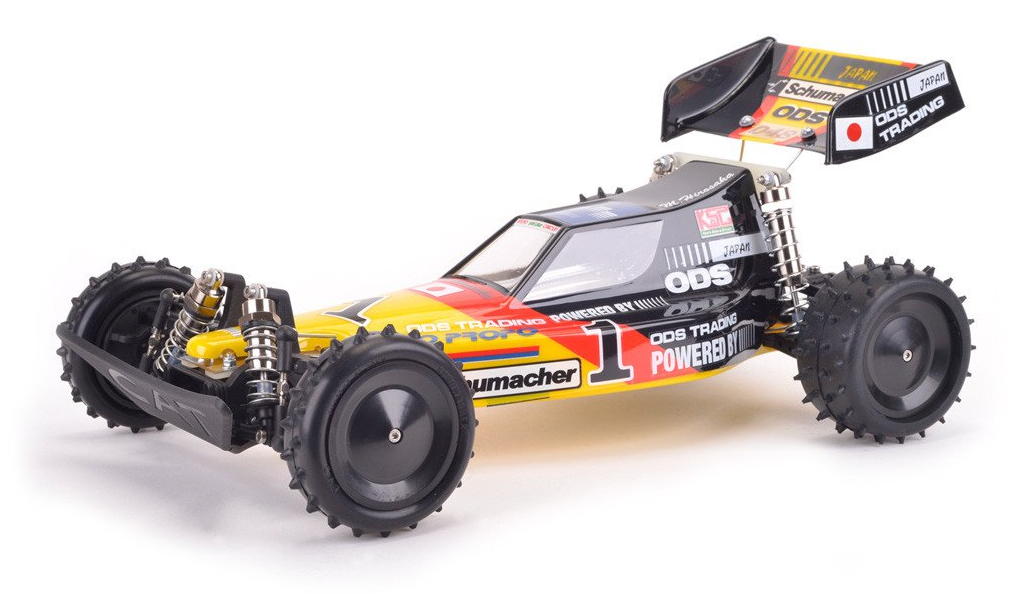
Schumacher CAT (which stands for Competition All Terrain) has been around for a long time. The CAT XLS (shown inset at left)
was a
4WD buggy introduced in 1986 which won a world title in 1987 driven by
Masami Hirosaka. That car was re-released in 2017 as a limited
edition and I built a copy in 2019.
I really enjoyed it until it burned up in my 2022 garage fire.
Replacing it directly proved to be effectively impossible, but later in
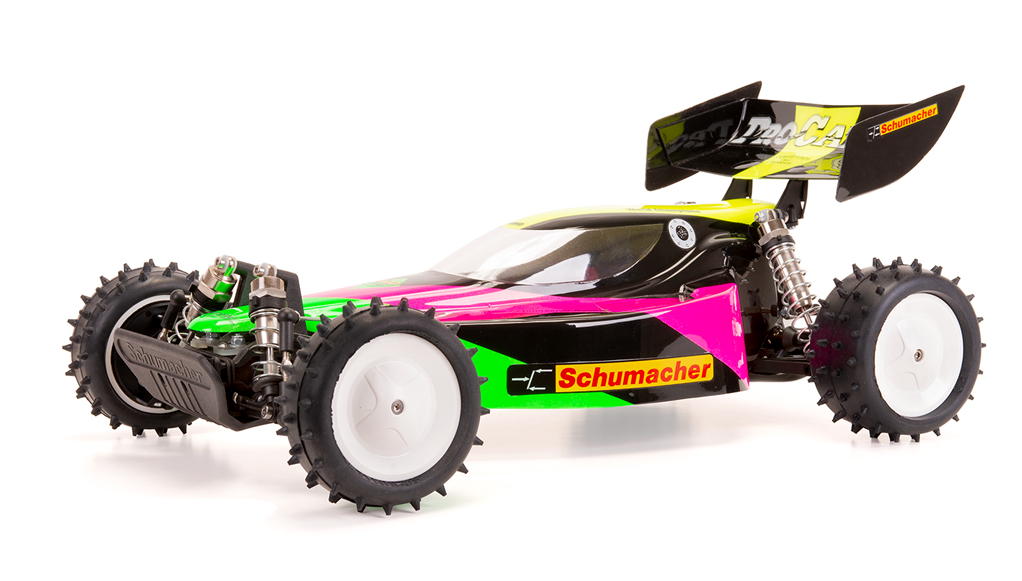
2022 Schumacher re-released the Pro-CAT (shown inset at right).
The Pro CAT was an improved version of the original which won a
European championship in 1990 driven by Phil Davies. I didn't get
one (or even know about it) right away, but as my replacement collection
took shape I found that I missed the oddity and "differentness" of the
CAT. These Schumacher buggies are absolutely nothing like the
Tamiya and Kyosho models I'm used to, and nothing like the Associated
RC10's which were out at the time either. I bought one on a whim
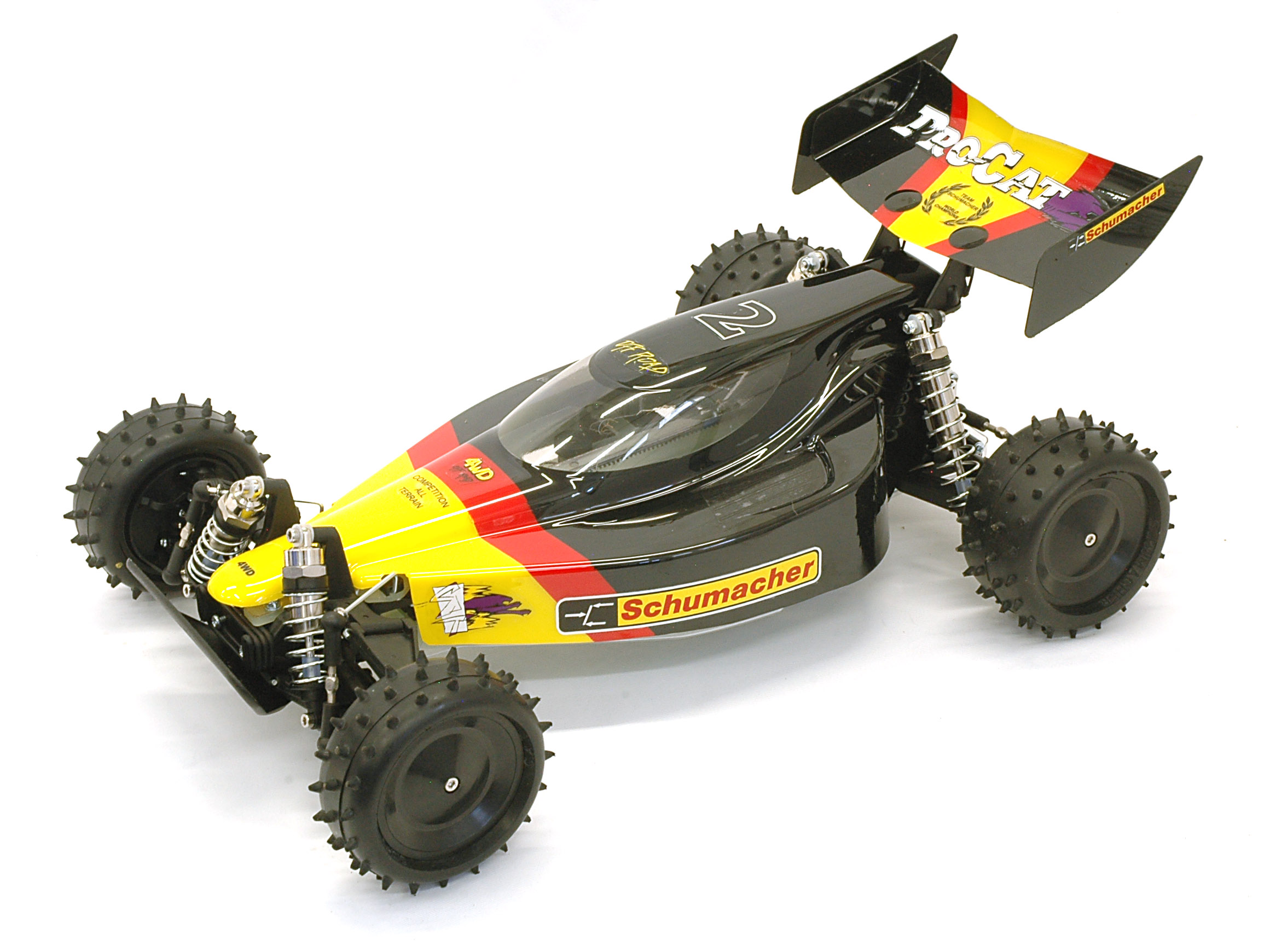
in 2026 and built it immediately. The livery of the Pro-CAT is
different than the CAT XLS, but I chose to paint it to match my original
as an homage and more effective replacement. The photos at the
top of page highlight the Pro-CAT as I finished it, and you can see how
it differs from either of the models shown in the insets.
This is the story of a pair of cats. The
Schumacher CAT (which stands for Competition All Terrain) has been around for a long time. The CAT XLS (shown inset at left)
was a
4WD buggy introduced in 1986 which won a world title in 1987 driven by
Masami Hirosaka. That car was re-released in 2017 as a limited
edition and I built a copy in 2019.
I really enjoyed it until it burned up in my 2022 garage fire.
Replacing it directly proved to be effectively impossible, but later in
2022 Schumacher re-released the Pro-CAT (shown inset at right).
The Pro CAT was an improved version of the original which won a
European championship in 1990 driven by Phil Davies. I didn't get
one (or even know about it) right away, but as my replacement collection
took shape I found that I missed the oddity and "differentness" of the
CAT. These Schumacher buggies are absolutely nothing like the
Tamiya and Kyosho models I'm used to, and nothing like the Associated
RC10's which were out at the time either. I bought one on a whim
in 2026 and built it immediately. The livery of the Pro-CAT is
different than the CAT XLS, but I chose to paint it to match my original
as an homage and more effective replacement. The photos at the
top of page highlight the Pro-CAT as I finished it, and you can see how
it differs from either of the models shown in the insets.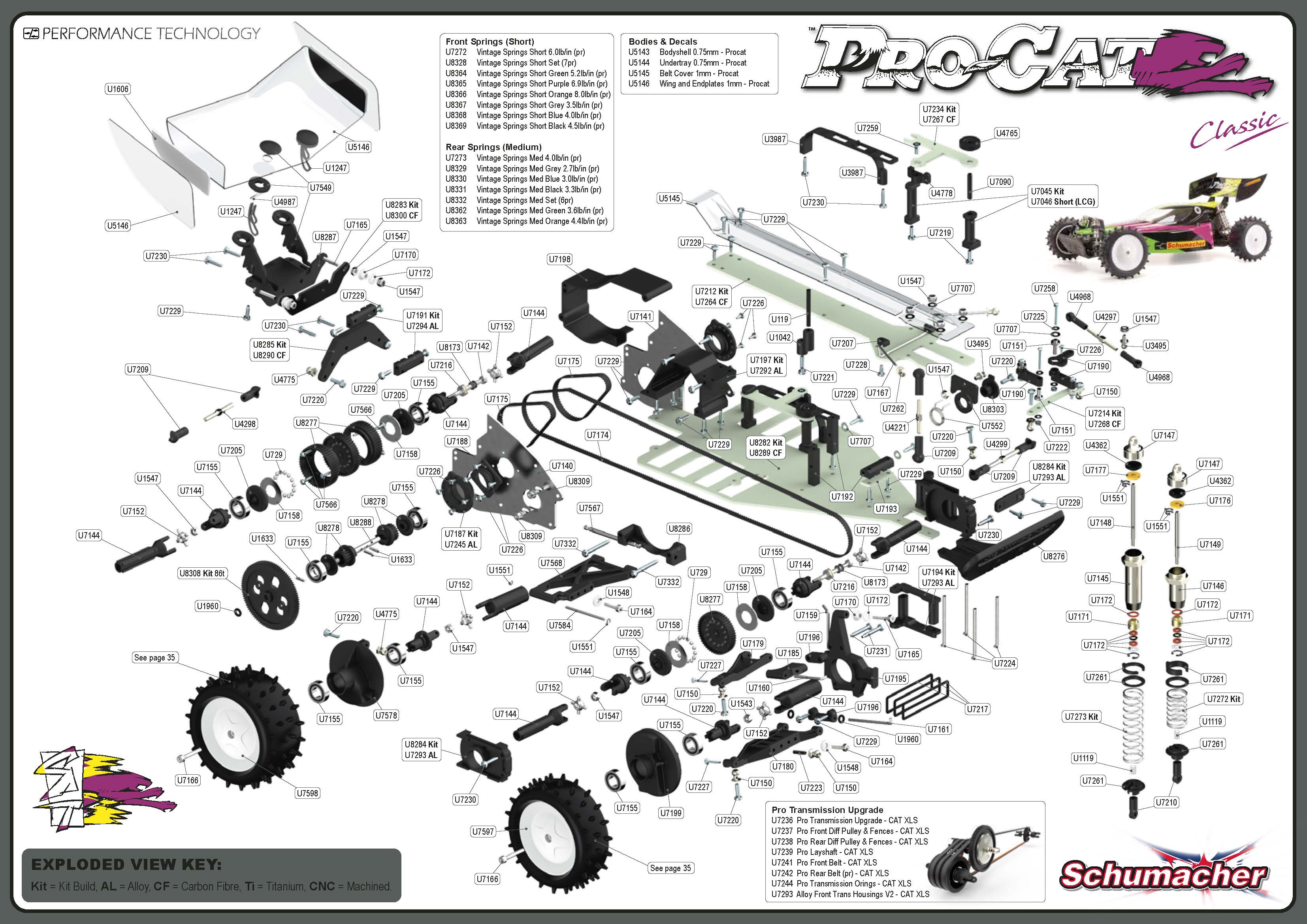 The
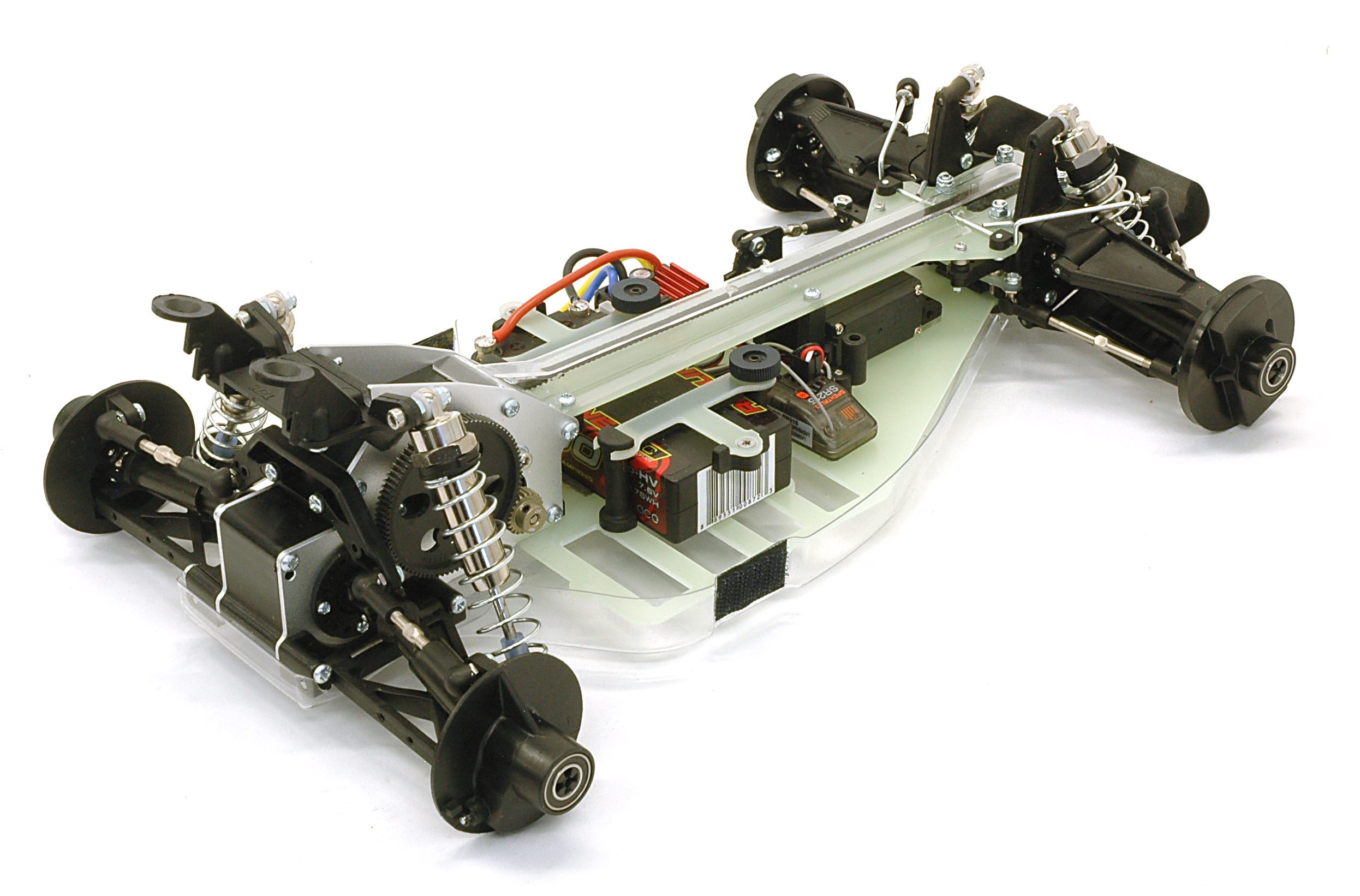
CAT is a 1/10 scale 4WD buggy with fiberglass chassis plates, belt
drive, and four wheel double wishbone suspension. Camber is fixed
but toe is adjustable with turnbuckles. Schumacher invented the
ball
differential in 1978, and the XLS buggy uses four of them. If this
sounds strange, it is. Read my build page to find out what they
are all used for. This model also has some of the most beautifully
machined aluminum shocks I have ever seen. The Pro-CAT is
extremely similar but uses a simplified setup with only two ball
differentials, and switches to white wheels with wider front
tires. I bought the original black wheels and substituted
them. Even though these are vintage replicas, the design has been
updated to
support brushless systems and Li-Po power. I installed a 17.5T
Hobbywing sensored motor powered by a 2s shorty pack in the XLS.
When I built the Pro-CAT, I changed to a brushed LRP motor which is
similar to what would have been available back in those old racing
days. I think the brushed motor is better suited to the
chassis. I've never used anything from LRP before, and somehow I
had it in my had that the L stood for "Losi". It doesn't.
LRP stands for Lautenbach Racing Products Gbmh and it is a German
electronics company. Seems like good stuff. LRP makes some
"Heritage Series" brushed motors that are similar to what they made in
days of yore. Instead of being rated in turns like everything
else, LRP assigns a color, a letter, and an RPM to each one: Yellow E =
17,500 rpm, Blue E = 29,000 rpm, and Orange HE = 33,500 rpm. I
naturally got the hottest HE version which is probably a bit much for a
4WD buggy so I used the smallest pinion possible. It's still
really, really fast and gets hot quickly.
The
CAT is a 1/10 scale 4WD buggy with fiberglass chassis plates, belt
drive, and four wheel double wishbone suspension. Camber is fixed
but toe is adjustable with turnbuckles. Schumacher invented the
ball
differential in 1978, and the XLS buggy uses four of them. If this
sounds strange, it is. Read my build page to find out what they
are all used for. This model also has some of the most beautifully
machined aluminum shocks I have ever seen. The Pro-CAT is
extremely similar but uses a simplified setup with only two ball
differentials, and switches to white wheels with wider front
tires. I bought the original black wheels and substituted
them. Even though these are vintage replicas, the design has been
updated to
support brushless systems and Li-Po power. I installed a 17.5T
Hobbywing sensored motor powered by a 2s shorty pack in the XLS.
When I built the Pro-CAT, I changed to a brushed LRP motor which is
similar to what would have been available back in those old racing
days. I think the brushed motor is better suited to the
chassis. I've never used anything from LRP before, and somehow I
had it in my had that the L stood for "Losi". It doesn't.
LRP stands for Lautenbach Racing Products Gbmh and it is a German
electronics company. Seems like good stuff. LRP makes some
"Heritage Series" brushed motors that are similar to what they made in
days of yore. Instead of being rated in turns like everything
else, LRP assigns a color, a letter, and an RPM to each one: Yellow E =
17,500 rpm, Blue E = 29,000 rpm, and Orange HE = 33,500 rpm. I
naturally got the hottest HE version which is probably a bit much for a
4WD buggy so I used the smallest pinion possible. It's still
really, really fast and gets hot quickly.I finished the models, as close as I could, to box art style. The spiked tires are quite hard so it slides and understeers a lot on pavement, but corners very well on gravel or grass. It also jumps completely flat making it look easy. I really like to drive this model, but it also looks great on my shelf next to other vintage 4WD buggies like the Tamiya Avante and the Kyosho Javelin. Even though it's legacy as a racing buggy means it should be pretty durable, the parts are so unusual and difficult to find that I'll be taking it pretty easy with this one.
Schumacher offers a wide range of high priced upgrades for this model, most importantly a racing transmission which costs almost as much as the kit. All of the FRP can also be replaced with carbon fiber, and there are many aluminum options as well. So far I have resisted and my copy is box stock.
 Page 1: XLS Assembly |
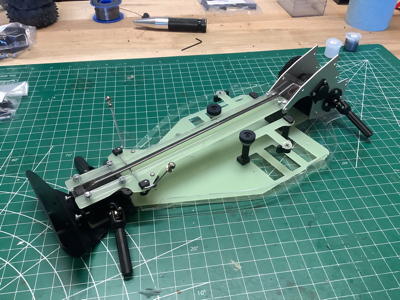 Page 2: Pro Assembly |
 Page 3: Final Photos |
| Original Build |
Replacement Build |
|||||||||||||||||||||||||||||||||||||||||||||||||||||||||||||||||||||||||||||||
|---|---|---|---|---|---|---|---|---|---|---|---|---|---|---|---|---|---|---|---|---|---|---|---|---|---|---|---|---|---|---|---|---|---|---|---|---|---|---|---|---|---|---|---|---|---|---|---|---|---|---|---|---|---|---|---|---|---|---|---|---|---|---|---|---|---|---|---|---|---|---|---|---|---|---|---|---|---|---|---|---|
|
|
Up to RC Index